PROPERTY & HISTORY

Looking to the past to create something for the future.
THE HENRY-BAYER HOUSE
A distinctive Spring homestead dating to the early 20th century.
Long before today's Spring–Woodlands corridor surrounded it, the house now known locally as the Henry-Bayer House stood along Aldine Westfield Road in a much smaller community shaped by agriculture, timber and the railroad.
Available property records date the 3,690-square-foot main residence to 1912, while local historical materials identify the Henry-Bayer House as dating to approximately 1914. Its precise construction date therefore remains uncertain, and the project uses the historically appropriate designation ca. 1912.
Research preserved by the Spring Historical Museum attributes the original house to a member of the Henry family. The identity of its specific builder has not yet been conclusively established.
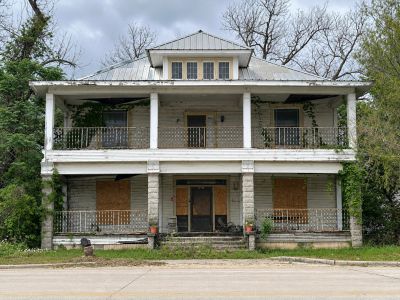
What is clear is that the house was unusual for Spring. Historical descriptions note that its broad two-story porches, substantial columns and comparatively flat, symmetrical façade differed from the late-Victorian architecture common in the community, suggesting a modified Greek Revival influence and perhaps the work of a builder or architect uncommon to the area.

SPRING AT THE TURN OF THE CENTURY
Railroads, timber and a growing Texas town.
The Henry-Bayer House emerged during one of the most important periods in Spring's history.
The railroad reached Spring in 1871, transforming what had been primarily an agricultural settlement. Around 1901–03, Spring became an important railroad junction and switchyard, with a roundhouse, extensive rail facilities and approximately 200 railroad workers. By 1910, the community's population had grown to roughly 1,200.
Sawmills and lumber operations also became part of the local economy. Spring was becoming a place where agriculture, transportation and small industry intersected - the environment in which the Henry-Bayer House first appeared.
One of the most recognizable survivors from that era is Wunsche Bros., established during Spring's early railroad boom and located only a short distance from the Bayer property. The historic building remains a prominent Old Town Spring landmark today.
THE BAYER STORY
From neighboring farms to a life in Spring.
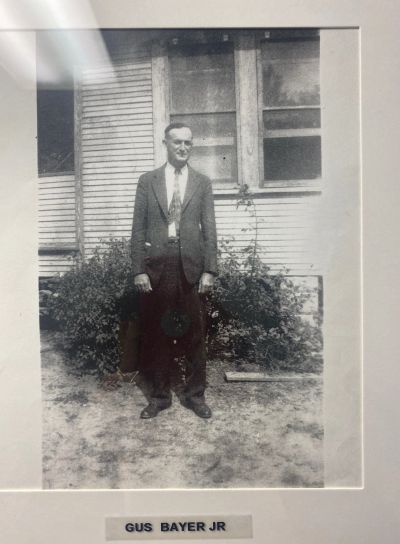
Gus Bayer Jr. and Metha Michel grew up on neighboring farms in the German farming community of Rosehill.
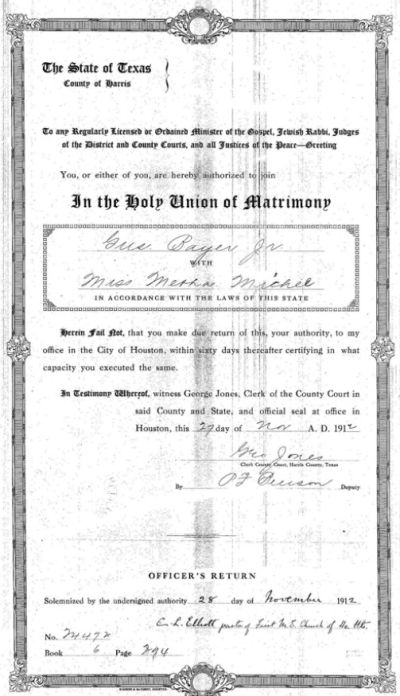
Their surviving Harris County marriage record provides an unusually precise connection to this period. The license was issued on November 27, 1912, and records their marriage on November 28, 1912 - coincidentally the same year that available property records associate with the earliest history of the house they would later call home.
The Bayers did not build the house. Their association with it came years later.
A 1962 Houston Chronicle retrospective recalled the couple's early life together and Gus's transition from farming into other enterprises. By the late 1920s, that transition would bring the family to Spring.
1928: THE BAYER HOMESTEAD
A house, two buildings and eleven lots.
By 1928, Gus Bayer was ready for something new.
A later newspaper account records that he moved his family to Spring and purchased a house, two buildings and 11 lots for $1,850, where he established an excelsior mill.
That description is particularly significant because the present property's legal description still includes Lots 1 through 11 in Block 2 of the Sellers subdivision, providing strong evidence connecting the 1928 purchase described in the historical account with today's Bayer Homestead.
The Spring Historical Museum identifies the house as the Henry-Bayer House and records that the Bayer family's youngest son, Edward “Buster” Bayer, was born there in 1930.
A house built in the early 1910s had found the family whose name would remain associated with it nearly a century later.
FROM FARMER TO ENTREPRENEUR
Lumber, industry and a changing Spring.
The Bayer story soon became part of Spring's business history.
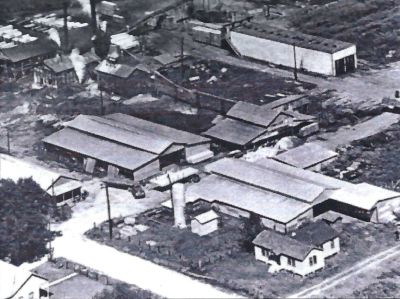
Historical materials preserved at the Spring Historical Museum identify Bayer Lumber Company as established in 1927. Gus Bayer's enterprises included an excelsior mill - which produced shredded wood fiber used as packing material - and developed into a substantial lumber operation.
Historical photographs show logs, lumber stacks, mill buildings and industrial equipment associated with the operation. Surviving Bayer Lumber Company equipment and artifacts are preserved today by the Spring Historical Museum.
In 1930, the Houston Chronicle also reported on another Bayer experiment: growing sisal-type plants near Spring as a possible source of commercial fiber.
Together, these stories reveal something important about Gus Bayer: his relationship with land wasn't simply about ownership. It was about finding productive new uses for it.

THE PEOPLE BEHIND THE NAME
From neighboring farms to a life in Spring
Gus Bayer Jr. and Metha Michel grew up on neighboring farms in the German farming community of Rosehill.
Their surviving Harris County marriage record provides an unusually precise connection to this period. The license was issued on November 27, 1912, and records their marriage on November 28, 1912 - coincidentally the same year that available property records associate with the earliest history of the house they would later call home.
The Bayers did not build the house. Their association with it came years later.
A 1962 Houston Chronicle retrospective recalled the couple's early life together and Gus's transition from farming into other enterprises. By the late 1920s, that transition would bring the family to Spring.
EXPLORE SPRING'S HISTORY
The story of the Bayer family is part of the larger story of Spring. The Spring Historical Museum in Old Town Spring preserves photographs, artifacts and records documenting the people, businesses and events that shaped the community.
SPRING LOOKS TO ITS PAST
Historic places find new purposes.
Spring's first great period of growth didn't last forever. The railroad roundhouse moved to Houston in 1923, and Spring's population subsequently declined dramatically.
But decades later, another transformation began.
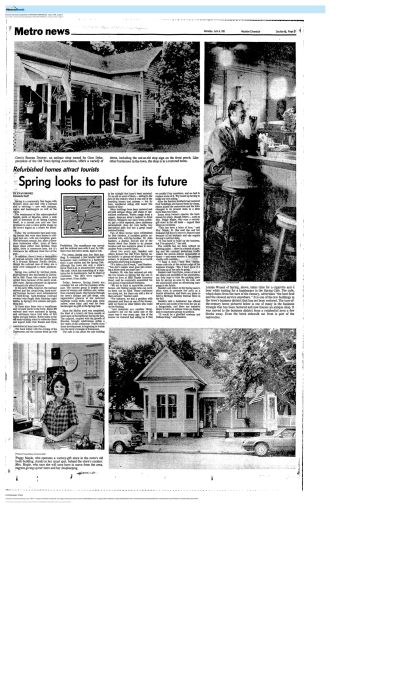
Historic houses and commercial buildings in old Spring were restored and adapted into shops, restaurants and gathering places. In 1981, the Houston Chronicle captured the movement with a remarkably appropriate headline:
“Spring looks to past for its future”
The article documented historic homes finding new commercial uses as the community that became Old Town Spring developed into a visitor destination.
Today, Old Town Spring remains one of the area's most recognizable historic districts, demonstrating that preservation doesn't necessarily mean freezing a building in time.
Historic places can remain relevant by finding new purposes.
THE PROPERTY TODAY
Preserving the identity, rebuilding for the future.
Today, the approximately 2.36-acre property remains along Aldine Westfield Road at the northern edge of Harris County, within the modern Spring–Woodlands corridor.
After more than a century, time and prolonged deterioration have taken a substantial toll on the Henry-Bayer House. The existing structure has deteriorated beyond the point where restoration is considered practical, and the development plan calls for its removal.
But the loss of the existing structure does not have to mean the loss of the house.
The vision is to recreate the Henry-Bayer House as a new structure built to modern standards while preserving the distinctive exterior character of the historic home - its broad two-story galleries, substantial columns, symmetrical façade, distinctive roofline and other recognizable architectural elements.
A newly constructed interpretation can retain the visual identity and historical connection of the original house while providing the structural integrity, accessibility, building systems, energy efficiency and functionality required for a modern hospitality and event property.
The goal is not to create a generic building that merely looks old. It is to allow the Henry-Bayer House to remain the architectural centerpiece of the property in a form capable of serving another century.

A vision for the next chapter. Conceptual rendering of a newly constructed interpretation of the Henry-Bayer House, preserving the historic home's distinctive exterior character while rebuilding to modern standards.