
Bayer Homestead & Wine Garden occupies an unusual position within the northern Houston market: immediately adjacent to the historic identity of Old Town Spring, yet connected to the larger Spring–Woodlands employment, residential, entertainment and hospitality corridor.
The initial market opportunity centers on a distinctive Wine Garden serving local residents, Old Town Spring visitors, and the broader Spring–Woodlands corridor. An established hospitality operator would have access to a substantial surrounding population, nearby employment centers, regional attractions, and an existing destination market. Private gatherings, live music, and future historic accommodations would provide complementary opportunities as the property develops.
Bayer Homestead can belong specifically to Spring while drawing from a market far larger than Spring.

Bayer Homestead does not have to create a destination identity from nothing.
Immediately nearby, Old Town Spring is home to more than 100 small, family-owned storefronts, including restaurants, shops, galleries, museums and other businesses occupying its historic district. Its visitor website continues to promote Old Town Spring as a place to shop, dine, explore and attend community events.
Old Town Spring also has a demonstrated history of attracting visitors through festivals and special events.
For more than three decades, the Texas Crawfish & Music Festival was one of the community's signature events. Beginning in 1986, the festival grew from a local celebration into a major regional attraction featuring live music, food, vendors and entertainment at Preservation Park.
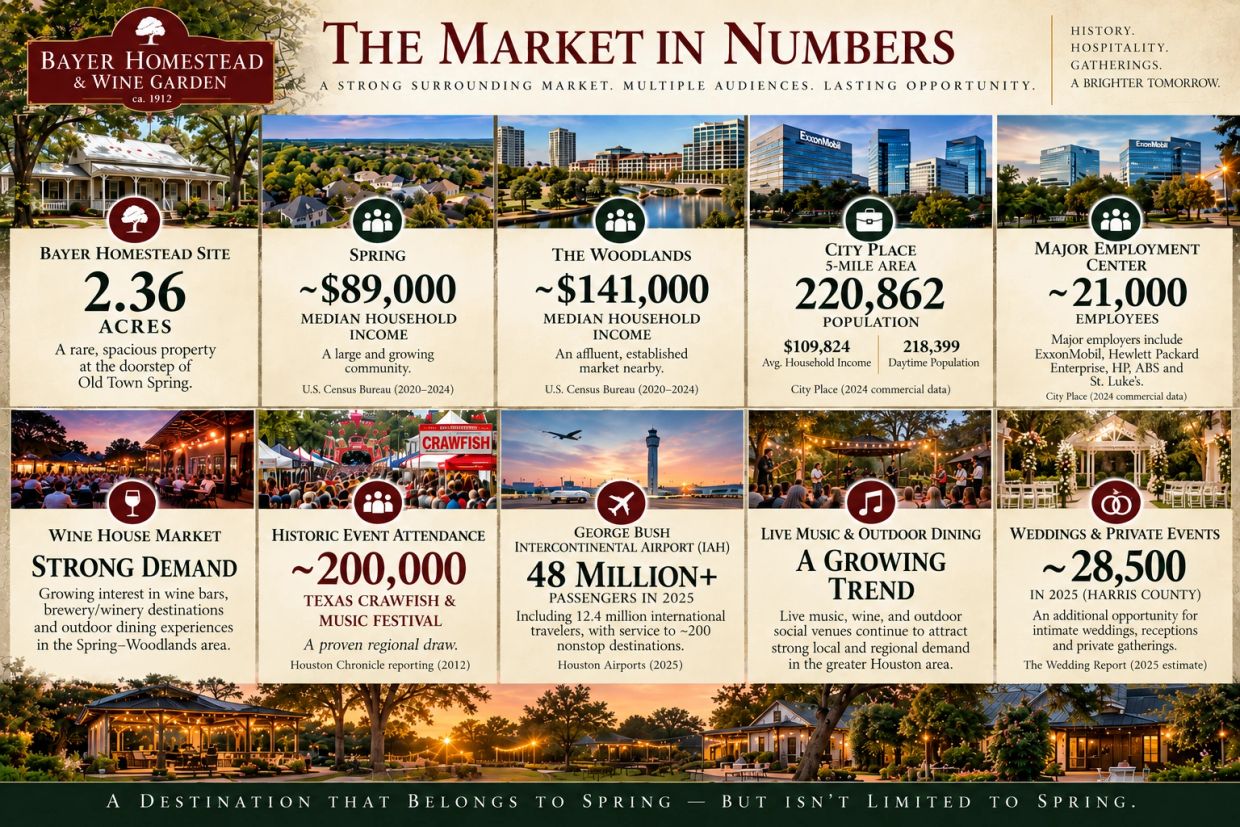
At its peak, the festival demonstrated just how large an audience Old Town Spring could attract. In 2012, organizers estimated that nearly 200,000 people visited Preservation Park and the surrounding Old Town Spring area during the event's two weekends.
The original Texas Crawfish & Music Festival is no longer presented as an annual Old Town Spring event, but its history remains significant: it demonstrated the ability of this relatively compact historic district to attract visitors from throughout the Houston region.
Today, festivals, markets, holiday celebrations and other special events continue to complement Old Town Spring's year-round shopping, dining and visitor activity.
Old Town Spring has demonstrated regional drawing power. Bayer Homestead creates an opportunity to add another destination to that established visitor environment.
Old Town Spring's visitor website features the historic district's 100+ locally owned shops, restaurants, attractions and events.
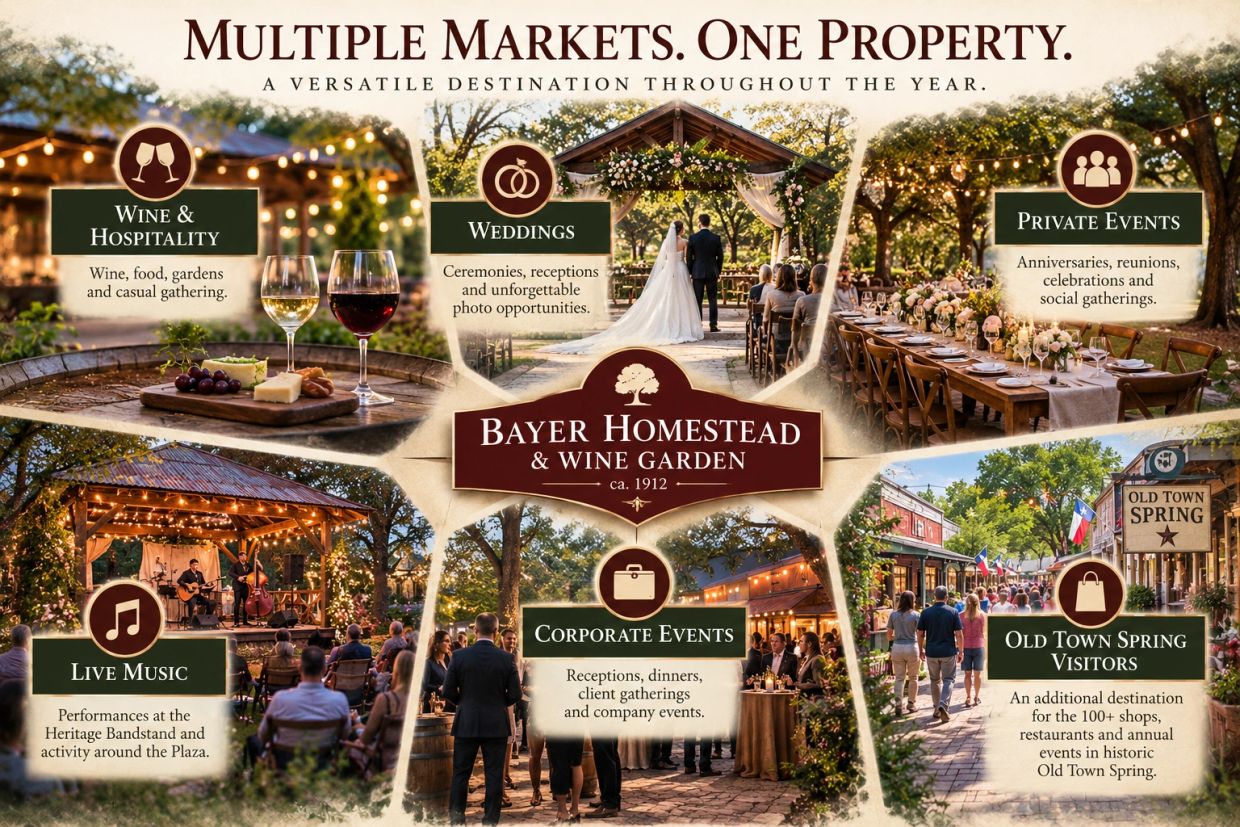
The compact scale of Old Town Spring is part of its charm - but it also creates an opportunity for Bayer Homestead.
The approximately 2.36-acre property provides enough room for gardens, mature trees, outdoor hospitality, live music, weddings, private events and quieter gathering spaces within moments of the historic district.
Rather than duplicating Old Town Spring's shops and restaurants, Bayer Homestead can offer a complementary experience:
Close enough to become part of an Old Town Spring visit. Large enough to become a destination of its own.
The property's immediate surroundings provide another layer of opportunity.
U.S. Census Bureau estimates for 2020–2024 place median household income at approximately $89,000 in Spring and approximately $141,000 in The Woodlands.
Nearby City Place reports an approximately 220,862-person population within five miles, average household income of $109,824, and a daytime population of 218,399 within that same radius. These are City Place's commercial-market figures rather than Census-defined Bayer Homestead trade-area measurements, so they should be viewed as evidence of the scale of the surrounding market rather than added to the Spring or Woodlands populations.
Median Household Income
Population
City Place has developed into one of northern Houston's significant employment centers.
City Place is home to approximately 21,000 employees, with major employers including ExxonMobil, Hewlett Packard Enterprise, HP and American Bureau of Shipping.
That proximity creates potential demand beyond leisure customers.
Corporate dinners, receptions, employee celebrations, client gatherings and other private events could provide weekday and non-wedding uses for Bayer Homestead.
A destination property near a major employment center has more than a weekend market.
The Cynthia Woods Mitchell Pavilion provides another indication of the area's regional draw.
In 2025, the Pavilion reported 349,948 Live Nation concert attendees, in addition to 41,805 attendees at its free performing-arts programs.
That doesn't mean Pavilion attendees automatically become Bayer Homestead customers. It demonstrates something more fundamental: hundreds of thousands of people already travel into the Spring–Woodlands corridor for entertainment and experiences.
The Woodlands adds an established concentration of shopping, dining, hotels and entertainment through destinations including Market Street, The Woodlands Mall and The Woodlands Waterway.
Bayer Homestead can become another reason to spend time in the corridor - and another destination to combine with an existing trip.
The surrounding corridor contains substantial hotel and meeting infrastructure.
City Place reports 564 existing hotel rooms, while the Houston CityPlace Marriott alone contains 337 guest rooms and more than 24,000 square feet of meeting and event space.
Farther north, The Woodlands has an established hotel and convention market serving business travelers, weddings, concerts and other regional events.
For Bayer Homestead, this means out-of-town wedding guests, corporate visitors and other travelers would not necessarily require lodging on the property itself.
That allows Bayer Homestead to concentrate on what makes it distinctive:
the destination experience.
While the initial development centers on the Wine Garden, the property's landscaped courtyard, Heritage Bandstand, and gardens may also accommodate intimate weddings, receptions, and private gatherings.
These uses would complement the Wine Garden's everyday business rather than serve as the foundation of the initial investment strategy.
As future development introduces the recreated Henry-Bayer House and guest accommodations, the property may become increasingly attractive for weddings and destination celebrations.
The flexibility to accommodate private events without constructing a dedicated wedding facility provides an additional opportunity for the hospitality operator and property ownership, subject to their eventual lease arrangements.
George Bush Intercontinental Airport adds another important layer to the location story.
IAH handled more than 48 million passengers in 2025, including a record 12.4 million international travelers, and Houston Airports reports nonstop connectivity to roughly 200 destinations.
Airport passengers themselves should not be treated as Bayer Homestead's market.
The significance is accessibility.
Destination weddings, family gatherings and corporate events become easier when guests arriving from outside Houston can remain in the northern portion of the metropolitan area.
Bayer Homestead's location near I-45, the Hardy Toll Road and Grand Parkway/SH 99 connects the property with communities and destinations throughout Greater Houston.
From The Woodlands and Conroe to the north, Houston to the south, Tomball to the west and Kingwood to the east, the property's accessibility substantially expands its potential audience beyond Spring.
Explore the interactive map below to see Bayer Homestead in relation to major communities, attractions, employment centers and regional destinations.

The initial market opportunity is centered on the Wine Garden's ability to attract repeat customers for wine, food, live music, and social gatherings.
The same courtyard, pavilion, and landscaped grounds may also accommodate private events and seasonal activities, allowing the hospitality operator to serve different customer groups without requiring separate facilities.
Future historic accommodations would introduce an additional market segment while benefiting from the destination identity established by the Wine Garden.
One property. Complementary experiences. Multiple reasons to return.
The historical identity of Bayer Homestead gives the project its story.
The acreage gives it room to turn that story into an experience.
Approximately 2.36 acres allow gardens, mature trees, the recreated Henry-Bayer House, Wine Pavilion, Heritage Bandstand, Courtyard, event spaces and quieter gathering areas to coexist within a single property.
That creates an opportunity substantially different from another restaurant storefront, event hall or conventional wedding venue.
Visitors can attend a wedding beneath the trees, hear music at the Heritage Bandstand, have wine in the Courtyard, walk through the gardens, photograph the recreated homestead or simply spend an evening on the property.
The property itself becomes the attraction.
Bayer Homestead's location places it between established centers of tourism, employment, entertainment and population rather than depending upon any one of them.
Its opportunity is to offer something distinctly its own: a historic, garden-oriented destination where hospitality, live music, private events and the story of Spring come together on 2.36 acres.
Bayer Homestead begins with something that cannot simply be manufactured: a genuine connection to the history of Spring.
The development plan adds the elements necessary to make that history useful again - hospitality, gardens, events, music and gathering spaces.
The surrounding market provides the audience.
Historic identity. Strong surrounding demographics. Major employment nearby. Regional entertainment traffic. A substantial wedding market. International accessibility.
Together, those factors create the market setting for Bayer Homestead & Wine Garden.
A destination that belongs specifically to Spring - but isn't limited to Spring.
Market data sources include the U.S. Census Bureau, City Place, The Cynthia Woods Mitchell Pavilion, Houston Airports, The Wedding Report, Old Town Spring Improvement District and published Houston Chronicle reporting. Current and historical figures are identified within the page where applicable.
We use cookies to analyze website traffic and optimize your website experience. By accepting our use of cookies, your data will be aggregated with all other user data.